Financial Red Flags: Why Money Is the Most Honest Signal in a Relationship
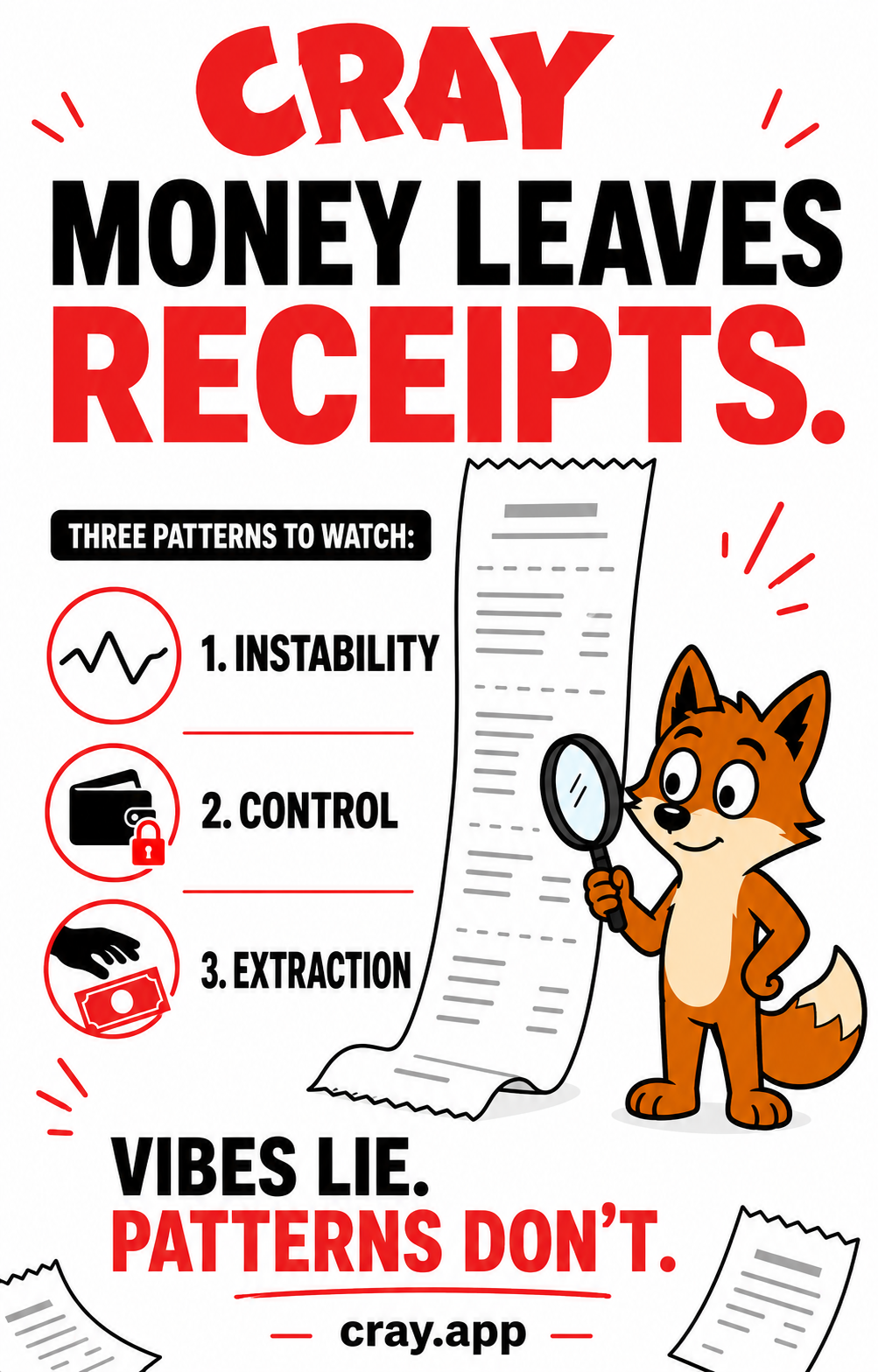
People can perform kindness. They can rehearse charm. But money leaves receipts — literally. That's why financial behavior shows up across the Cray platform: in the CrayScore™'s Responsibility category, in its Control & Coercion category, and in four dedicated Exploitation items on the SchemerScore™. Few dimensions of behavior are harder to fake over time.
Three different money problems — and only one is forgivable
1. Instability. Job instability, unreliable bill-paying, unstable housing, a bankruptcy. These flags matter, but they're the gentlest of the three — people recover from hard seasons, and honesty about a rough patch is itself a green flag. What the assessment weighs is the pattern: is instability a chapter, or the whole book?
2. Control
Financial control is a different animal entirely — it lives in the Control & Coercion category for a reason. Monitoring your spending, demanding access to your accounts, using money as leverage ("after everything I've paid for…"), or engineering your financial dependence. Financial control is one of the most common threads in abusive relationships precisely because it works: it's hard to leave someone who holds your resources.
3. Extraction
The SchemerScore™ exists for the third kind: people for whom the relationship is the transaction. Its exploitation items track financial solicitation (the emergencies that always need your card), gift fishing, financial entitlement, and outright transactional intent. Its deception items catch the setup: luxury appearances, image crafting, and claims of financial independence that never quite survive contact with the check.
The tells, in plain language
- Their lifestyle and their visible means don't add up — in either direction.
- Money "emergencies" appear early, and always with urgency.
- Generosity comes with a ledger — every gift gets invoked later.
- They know your financial details, but theirs stay vague.
- You feel weird saying no to requests that keep getting bigger.
The honest caveat
A single money mistake isn't a verdict — Cray weighs severity and frequency, not perfection. But if reading this felt like reading someone's biography, that's data. Run a SchemerScore™ — it's free, it's private, and no one is notified. Ulterior motives have patterns, and patterns can be scored.
